

For years, travel loyalty has followed a familiar pattern: points, tiers and rewards. Customers understand it, and businesses benefit from repeat bookings and incremental spend.
But loyalty data exists alongside a much broader set of signals that shape the travel experience: booking context, live journey updates, digital behaviour and service interactions. And too often, these worlds remain disconnected.
Loyalty programmes hold valuable customer identity and history, while operational and experience data capture what’s happening in the moment. When these aren’t connected, brands recognise customers in theory but struggle to respond to them effectively in practice.
There’s an opportunity for brands to stop viewing loyalty data separately and integrate it with operational signals, so journey decisions reflect both who the customer is and what they’re going through.
The four types of data guiding customer journeys
Travel brands already capture a huge range of customer data, but that information is often spread across departments and systems. Without a unified view, the customer journey is treated as separate moments rather than a single, continuous relationship.
Creating that continuous relationship relies on four data types: identity, transactions, behaviour and sentiment. Each has its own value, but together, they provide the inputs for loyalty data to become an experience engine, informing decisions across the journey.
The connected loyalty data model

The connected loyalty data model
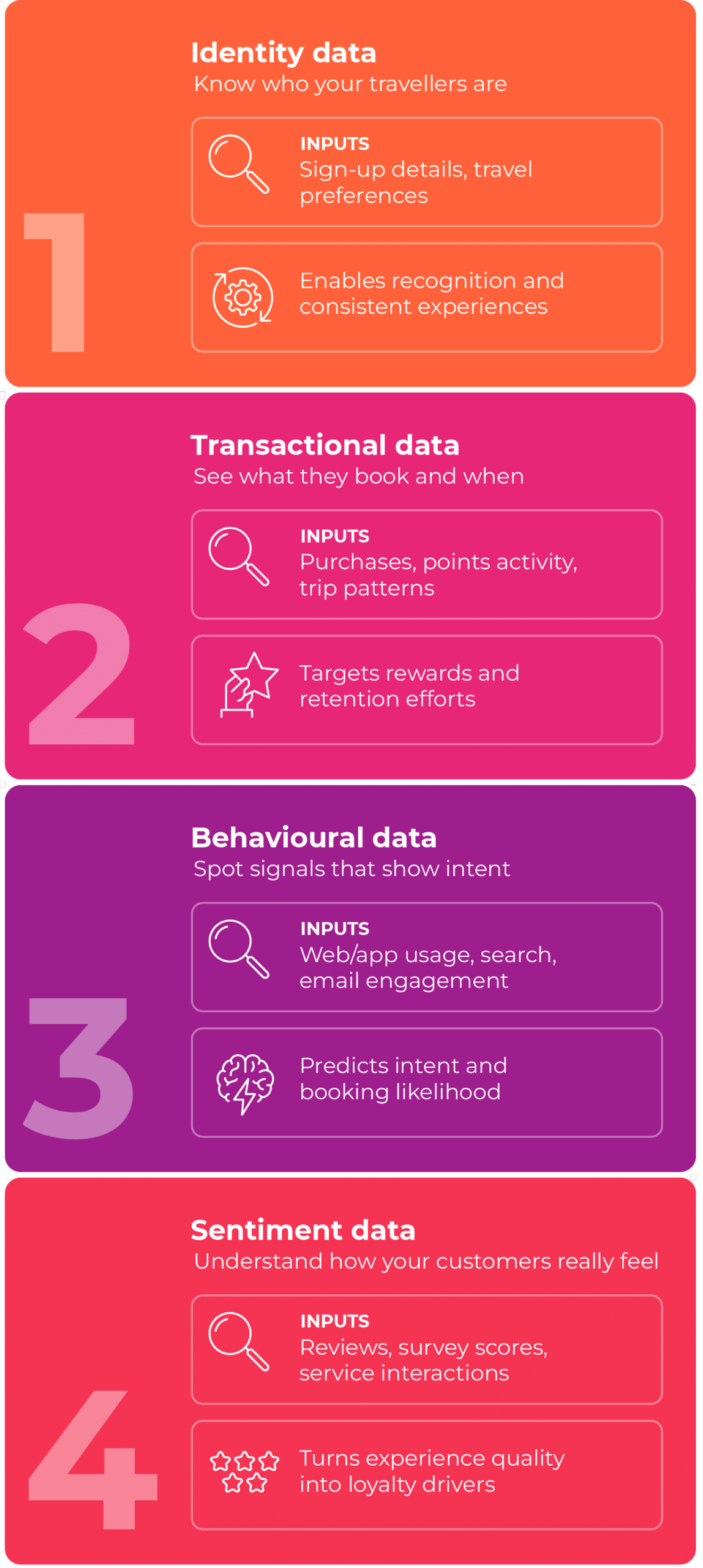
Bringing additional context into the loyalty view moves the focus from points earned to personalised service and long-term value: reducing friction, supporting recovery when things go wrong, and helping brands stand out through how they treat customers.
Connecting loyalty, experience and operational data in the customer experience
Linking loyalty, booking, digital, and service signals to a single customer identity enables travel brands to create contextualised interactions across the end-to-end experience, rather than resetting at each touchpoint.
The result is a more joined-up journey, especially when plans change or customers need additional guidance. For example:
Disruption handling: A frequent traveller misses their connection. Loyalty history and live flight data trigger automatic rebooking and clear next-step guidance before they ask for help.
First-time long-haul traveller: An infrequent traveller keeps checking baggage and transfer info. Their profile and app behaviour prompt simple pre-trip guidance and clear support options, reducing uncertainty.
Delayed room on arrival: A hotel room isn’t ready. Loyalty tier and stay history guide who takes priority, who receives a temporary benefit (such as a drink voucher or late checkout), and who gets proactive updates, managing expectations before frustration builds.
Connecting the journey at these high-impact moments means bringing people, technology and processes together so loyalty insights inform what happens next.
1. People: aligning teams around a shared customer goal
Improving the travel experience using connected data means breaking down the usual silos between loyalty, web and app, insight and analytics, UX/UI, development and operational teams.
Clear ownership is critical. A named product or journey owner should be accountable for how customer insight is used end to end, reducing hand-offs, closing capability gaps, and ensuring decisions are made with the full customer context in mind.
This approach helps insights move beyond reporting into frontline action. Customer support and service teams can see relevant history and current signals together, respond faster, and tailor how they handle situations. Behavioural and service data also highlight emerging issues earlier, allowing teams to step in before problems escalate.
2. Technology: integrating data to decide next steps
Building a unified view of the customer means connecting loyalty data with booking engines, CRM systems, app behaviour and service interactions, so teams aren’t working with partial profiles.
With a unified data foundation, decision engines can use combined signals to choose the next best action in real time or near real time – whether that’s a service prompt, an offer, a recovery step or a handover to a frontline team. It also reduces friction for customers, as they’re not repeating information at every step.
At this point, travel brands can apply AI to factor behaviour and live context into decisions, enabling consistent, personalised responses at a scale that static rules can’t support.
3. Processes: Ensuring insights drive strategic action
Without clear processes, teams tend to tweak customer interactions piecemeal: a better email series here, a new offer there, an app update somewhere else. Improvements have been made, but the overall experience feels fragmented.
For a smooth end-to-end journey, teams need to agree on decision paths for high impact moments. At what point does the customer get handed to a person rather than a chatbot? Who should intervene? Through which channel? Process clarity prevents inertia and resolves issues quickly.
Crucially, service outcomes should flow back into the loyalty view, so the programme learns from real experiences. This drives more consistent journey handling, without losing sight of individual customer needs.
The business impact of connected loyalty experiences
When customers feel recognised and supported, they lean further into the brand relationship. They join loyalty programmes, redeem offers and consolidate their spend.
Not only does this make for happier travellers, it delivers commercial benefits, including:
- Lower churn: Loyalty data helps brands understand how journey outcomes influence customer behaviour and take avoiding action. Behavioural and service signals also highlight intent or emerging risk, so teams can step in to reassure customers, prompt completion or resolve issues, preventing avoidable drop-off.
- Higher retention and repeat bookings: Better handling during disruption and recovery protects trust when it is most fragile. Customers are more willing to book again because previous journeys were handled well.
- Higher lifetime value: Customers who feel understood and supported are more willing to share data, engage with loyalty programmes and increase their spend. Identifying drift early also helps brands to re-engage customers whose loyalty may be cooling off.
- Lower service costs: Focusing on high impact moments avoids blanket personalisation and wasted effort. Brands can prioritise support where it has the greatest effect and automate routine interactions without degrading the customer experience.
Five key takeaways for travel brands
Points and tiers will continue to play an important role in customer engagement. But deeper loyalty comes from how effectively you support customers through uncertainty, and how consistently the experience reflects what you know about each traveller.
Here are five takeaways that can help your brand strengthen customer journeys through better use of loyalty information:
1. Use loyalty data to influence journeys as they unfold
Apply loyalty insights to support customers before, during and after travel, particularly in moments of uncertainty, disruption and recovery.
2. Bring identity, transaction, behaviour and sentiment data into a single working view
Combining these signals around the customer enables more informed decisions and more consistent journey handling.
3. Focus effort on high impact moments
Prioritise “pinch points” such as pre-trip reassurance or disruption recovery, where experience quality significantly affects future behaviour.
4. Design loyalty-led interactions to influence long-term customer value
Focus on earlier intervention, lower friction and more considered support to reduce churn, increase repeat booking and consolidate spend over time.
5. Link journey outcomes to loyalty strategy
Use feedback to guide where loyalty efforts are focused, how customers are prioritised, and which moments warrant greater investment.
Ultimately, loyalty in travel is only as strong as the data that underpins it. Brands that use rich customer information to shape experiences throughout the journey are better positioned to build trust, influence behaviour and increase lifetime customer value.
Was this helpful?
Thank you for your feedback
0 · 0


Ready to turn your loyalty data into a tool that shapes exceptional experiences?
Get in touch to find out how our Travel and Leisure experts can help you build stronger deeper loyalty with your customers.