
The Balance Advantage
How organizations crack the growth-efficiency code

The Balance Advantage
How organizations crack the growth-efficiency code
Today, organizations face a strategic tension: they’re simultaneously being asked to grow and become more efficient, under budget pressure, with workforces stretched by years of continuous change.
The Transformation Index 2026 finds that only 21% of organizations have reached an advanced or leading stage of transformation maturity, and only 6% consistently deliver strong transformation outcomes.
Get the full report and discover what transformation leaders are doing differently to find their balance advantage.
With research insights provided by:

The ground is shifting faster than most organizations can adapt. Macroeconomic pressures are increasingly interconnected, reinforcing one another and changing daily rather than over the predictable cycles businesses once planned around. Navigating multiple scenarios at the same time has become the new reality.
A new economic cycle is already taking hold, driven by agentic AI and its profound impact on how organizations operate, compete and transform. Investment trends underline the scale of this shift: global IT spending grew by 14% in 2025, the fastest rate in three decades and comparable to the internet and eCommerce boom of the mid-1990s.
The pace of change is without precedent; its impact cuts across every industry and function, and there’s no sign of it plateauing. That’s what makes this not merely a cycle but an AI supercycle.
1 IDC’s Worldwide Black Book Forecast, 31 March 2026
A defining strategic tension has emerged. Growth tops the agenda, with organizations ranking it among their three most important business objectives for the coming 12 months. Yet efficiency features almost equivalently.
The paradox is sharp: do more with less, while having a greater impact. For private organizations, the imperative is to grow revenues and market share; for public sector organizations, it’s to deliver better citizen services, both while reducing costs, resources and time.
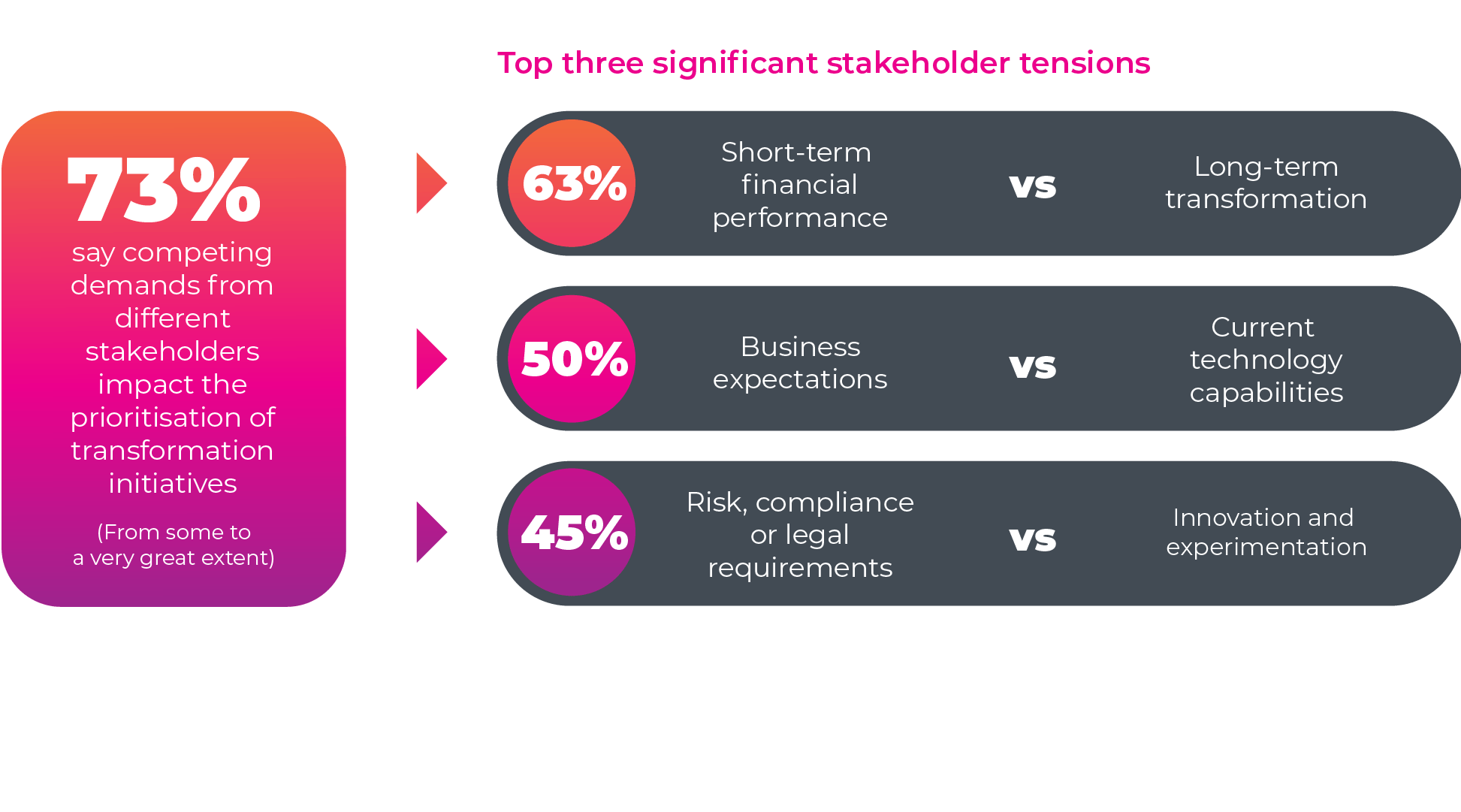
Most organizations are not standing still. They’re investing, experimenting and adapting. But progress is uneven, and often hard to scale, particularly with different stakeholder demands pulling organisations in different directions.
How are leading organizations finding their balance advantage and delivering transformational change?
What’s required today: a reinvention of business and operating models – one that doesn’t treat growth and efficiency as opposing forces, but as a unified engine. Cracking this code is the defining transformation challenge of today.
To understand organizations approaches to transformation and their transformation maturity, Gate One commissioned a global IDC study of 750 participants. Using a mixed-method approach, the research examines transformation maturity across large global organisations, analysing how they’re progressing through their transformation journeys and where the gaps between ambition and execution are widest. It also identifies the defining characteristics of transformation Leaders, the top 11% of organizations that have built transformation into a sustained organizational capability and translates those findings into concrete guidance for C-suite executives looking to accelerate their transformation impact now.
Full details of the methodology can be found in the report.
Delivering value
Creating new revenue streams through innovative business models, products and services
Improving performance
Driving greater efficiency by standardizing and unifying core processes
Evolving people
Strengthening workforce, skills and culture across structures and teams
Notes:
n = 750. Figures may not total 100% due to rounding
Source: IDC White Paper “The Balance Advantage: How organizations crack the growth-efficiency code” (IDC #EUR154681426, July 2026); n = 750.
How are leading organizations finding their balance advantage and delivering transformational change?
Across all maturity stages, organisations face a consistent set of systemic challenges that cut across technology, value, operating models and people. This isn’t a transitional issue, it persists even in more advanced organisations, suggesting that the balance itself is a defining capability of modern organisations.
Artificial Intelligence Business Impact

Only 1 out of 3 GenAI/Agent initiatives has met or exceeded expectations
Skills & Capability Gaps

61% of all respondents identify skills gaps as a structural challenge that does not go away with experience.
Short-term vs Long-term tension

63% of all respondents struggle to balance immediate delivery pressures against long-term transformation goals.
Transformation fatigue

74% of all respondents feel that ongoing transformation efforts are making it hard to sustain momentum.
Note: n = 750
Source: IDC White Paper “The Balance Advantage: How organizations crack the growth-efficiency code” (IDC #EUR154681426, July 2026); n = 750.
How are leading organizations tackling these challenges to find their balance advantage and deliver transformational change?
Transformation reaches every seat at the table, and each leader views it differently. When the C-suite reads the growth-efficiency tension through separate lenses, the organization risks pulling apart.
Leading organizations aren’t just better at transformation. They’ve fundamentally rewired how they operate, measure and sustain change, turning what others treat as a project into a permanent organizational capability. Five disciplines, aligned with the transformation framework, separate them from the rest.
Alignment and prioritization of transformation areas and initiatives
Clear ROI and value measurement never stops
Change management is a core organizational capability
Data and governance are non-negotiable
The operational agenda goes far beyond efficiency
What are transformation leaders doing differently to balance growth and efficiency?
The Transformation Index is an annual barometer that examines transformation maturity across large global organizations, analyzing how they’re progressing through their transformation journeys and where the gaps between ambition and execution are widest.

Discovering how transformation leaders have rewired the ways their organizations operate, measure and sustain change.

Exploring the ways that leading organizations have tapped into the power of adaptability to unlock transformation success.