

Personalisation has long been hospitality’s favourite promise for years. Yet for many, the experience still feels stitched together.
A thoughtfully curated offer on the booking page doesn’t always translate into a warm welcome at check-in or tailored service during their stay.
And it’s not because hotels lack customer information. Operators hold vast volumes of data across digital channels, loyalty schemes, property management systems and post-stay feedback. So, what’s missing? The ability to connect the dots, and act on these insights.
The next chapter belongs to hotel leaders who align teams, technology and AI tools around a clear aim: delivering experiences that feel seamless, relevant and human – from start to finish.
The real challenge isn’t data collection, it’s orchestration
Hotels capture data at every turn – browsing behaviours, booking records, ancillary purchases, service requests and reviews. But too often, those insights sit in isolated systems.
Customer relationship management (CRM) platforms don’t talk to property management systems. Marketing can’t see what operations see. Teams chase different KPIs, and personalisation loses its way when customers step through the door. There’s no ‘golden thread’ running through the guest journey.
When systems don’t connect, every interaction has to work harder. Staff are forced to bridge gaps manually, relying on incomplete profiles or past interactions they can’t see in full. The result? Inconsistency at best. And at worst, a compromised guest experience.
Our Transformation Index research shows that leading organisations ‘champion their data’, embedding it into everyday decisions and using it to guide transformation. For hotel operators, this means treating guest data not just as a record, but as a strategic asset that drives personalisation.
Reconnecting the customer journey
To personalise well, you need to see the whole picture.
True end-to-end personalisation means consolidating fragmented information into core data pillars and using that insight to shape future interactions.
Understanding where the data opportunities sit, and how they can shape the guest journey, turns abstract information into better guest experiences:
- Pre-booking and booking: Targeted ads and dynamic offers; loyalty-aware pricing; pre-arrival emails that reflect browsing and past spend; app journeys that recognise intent.
- On-property: Front desk teams see preferences at a glance; in-stay prompts arrive at the right moment; menu, facilities and experience promotions reflect who the guest is and what they value.
- Post-stay: Feedback loops drive learning; follow-ups feel thoughtful; loyalty grows because guests feel recognised, not pushed into generic upsells.
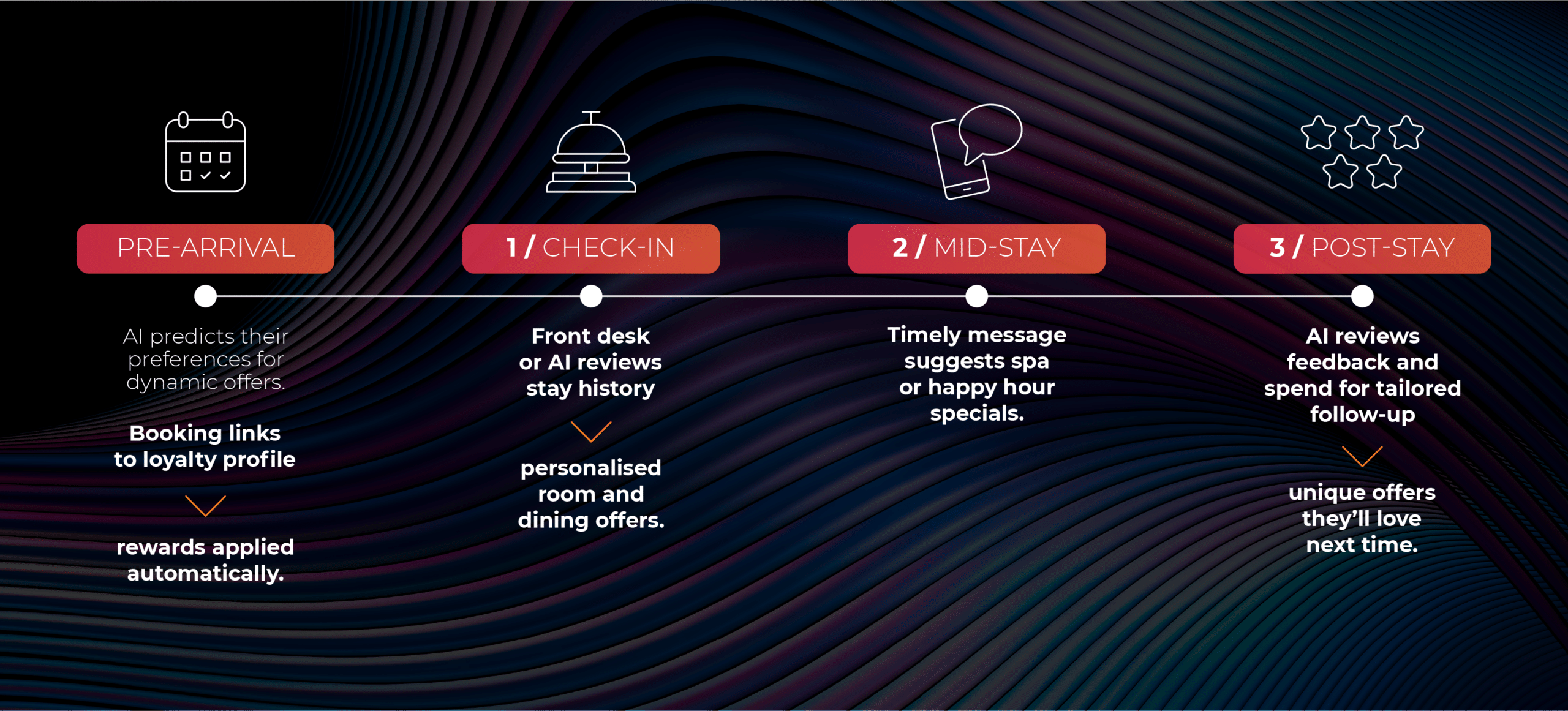
In a well-personalised experience:
- The guest books online and their booking automatically links to their loyalty profile, earning them rewards
- When they check in, the front desk sees their stay history and personalises their room and dining offers based on current circumstances and past behaviours
- Mid-stay, a message lands at a timely moment to recommend on-property offers – from happy hour specials in the bar to available spa services
- After they leave, a tailored follow-up reflects their stay and offers something they’re likely to love next time
When data flows across the journey, personalisation becomes intuitive, and experiences feel relevant and meaningful.
Personalisation happens when data becomes actionable
Data is only valuable when it drives action. Think of every data point as a signal. Together, these signals reveal who your guests are and what matters to them. Some data points reveal who a guest is. Others show how they behave, or what they need in the moment.
When these signals are connected and easy to act on, personalisation stops being a front-end flourish and flows naturally from one moment to the next. This means every personalised interaction contributes to outcomes that matter: guest satisfaction, loyalty and operational efficiency.
A practical way to make sense of these signals is to view them through three lenses. Some are foundational, others more adaptive – subtle cues that shift throughout the journey:
| Data Type | Examples | What It Unlocks |
|---|---|---|
| Transactional | Booking history, loyalty tier, on-property spend | A foundation for guest identity and value, enabling recognition and rewards |
| Behavioural | Browsing patterns, offer responses, service preferences | Insight into intent and interests, shaping how experiences are designed |
| Contextual | Arrival time, party mix, location, in-stay choices | The ability to respond in the moment with relevant, well-timed interactions |
Used effectively, these signals unlock new opportunities, from recognising returning guests to responding in real time with prompts that make a stay feel considered.
But data on its own doesn’t create memorable moments. Impactful personalisation comes from a strong organisational culture: defined ownership, shared accountability and cross-functional teams that treat guest information as a strategic asset.
The biggest gains come when frontline teams, not just leadership dashboards, have access to clear, actionable insights.
Is AI the accelerator?
Many hotel operators see AI as the fast track to more dynamic guest experiences, and they’re right to be excited. But AI isn’t a shortcut. It works best when it sits on top of strong data foundations.
With those foundations, AI can move personalisation from static campaigns to hyper-contextual interactions that unfold in real time. It can analyse data signals to suggest ‘next best actions’ at precisely the right moment.
This new level of agility opens the door to practical, guest-focused opportunities, such as:
- Late check-out offers, triggered by low occupancy forecasts and guest stay patterns
- A breakfast slot suggested at the exact moment the guest is likely planning their morning
- An in-room message updated in real time to reflect booking changes or on-property activity
The rise of AI… behind the scenes
AI isn’t just about guest-facing moments. Behind the scenes, it’s transforming how teams operate.
AI can drive operational gains by anticipating demand, optimising housekeeping schedules and matching staffing levels to guest flow. It removes friction behind the scenes so teams can focus on creating a seamless stay for guests.
But for many hotel operators, AI is still a relatively new opportunity. That can bring uneven maturity – a strong ambition at the top but limited readiness in data, governance or culture.
Without solid foundations, early AI efforts risk being isolated experiments rather than scalable tools. This often shows up as pilots that don’t scale, frontline teams who are unsure how to use new tools, or personalisation initiatives that stall before delivering real impact.
In these early stages, AI programmes need guardrails to build trust and ensure they deliver the right kind of impact. That starts with putting a set of principles in place, including:
- Transparency about how guest data is used
- Bias monitoring and oversight to keep recommendations fair
- Firm boundaries to prevent personalisation from feeling intrusive
Applied well, AI shifts personalisation from a top-down strategy to something teams can deliver in the moment. It sharpens decisions, speeds up responses and makes personalisation part of the everyday experience.
Creating dynamic guest experiences: Whitbread’s transformation
Whitbread, owner of Premier Inn, faced a critical challenge: a 40-year-old booking platform that couldn’t keep pace with modern guest expectations. Outdated technology was limiting the company’s ability to understand customers, tailor experiences and scale personalisation programmes with confidence.
Gate One partnered with Whitbread to replace its legacy platform with a modern, API-based system, creating the foundation for a unified guest view and smarter personalisation.
For Whitbread, strong data foundations underpin a more flexible, responsive and guest-centred experience. By integrating more than 60 systems, including finance, reporting, check-in and payments, teams have the information they need in one place to act quickly and consistently across the customer journey.
Those connected systems give Whitbread greater visibility of operational bottlenecks and make it easier to deliver the fast, frictionless experiences guests expect.
The modern platform has also opened up new ways to personalise the digital journey. A/B testing, better tracking and dynamic offers give Whitbread the flexibility to adapt its proposition for both leisure and business customers. Integration with third-party services, from car hire to local attractions, is also turning Premier Inn from a hotel booking site into a broader leisure platform.
A test-and-learn approach was key to Whitbread’s success. Early pilots allowed teams to quickly spot what worked, refine what didn’t, and build confidence across the organisation.
Crucially, the programme wasn’t just a technology upgrade. Gate One introduced Business Solution Owners to bring Whitbread’s digital, operational and customer experience teams together. This cross-functional model has made personalisation part of how the organisation works:
- The customer perspective shapes design and delivery decisions
- Operational realities inform how new tools are rolled out
- Data and technology are aligned to business outcomes, not the other way around
For other hotel operators, Whitbread’s experience shows that modern infrastructure has the greatest impact when it sharpens how teams understand and serve guests.
Build on solid ground, then scale
The next chapter of guest personalisation won’t be won by those with the most data, but by who can move fastest from insight to action. Our research shows that leading organisations “build for action, not perfection”. They don’t wait for flawless data, they start with what’s good enough to guide decisions and improve over time.
You don’t need to start from scratch. You likely already hold rich data across booking platforms, loyalty schemes, property systems and guest feedback channels. Start with the basics: fixing fragmented data, creating a single guest view, and testing a few high-value use cases (for example, early AI applications) to prove the impact. Start small to build momentum, making bigger changes easier to deliver.
Secondly, make your data accessible. Give teams the tools to self-serve, explore insights and personalise in the moment. This shift, from centralised dashboards to frontline enablement, will empower your teams and drive data enablement.
As systems mature, the focus moves from tools to culture. Shared ownership, clear governance and embedding personalisation into everyday actions matter just as much as the technology stack. That’s how personalisation moves beyond pre-arrival campaigns to a woven thread through every stage of the guest experience.


Looking to deliver experiences for your guests that feel seamless, relevant and human – from start to finish?
Get in touch to find out how our Travel and Leisure team are helping businesses tap into the power of data and AI.


